
The Land’s End peninsula represents one of Britain’s most remarkable prehistoric achievements—an entire landscape transformed into an astronomical instrument. Modern archaeological research reveals that the concentrated monuments scattered across this region weren’t isolated religious sites but components of an integrated system designed to track the sun’s annual journey, particularly its critical turning points at solstices.
Geological features provided the foundation for this astronomical landscape. A granite ridge extends southwest along the peninsula, naturally aligned with winter solstice sunset direction. Archaeoastronomer Carolyn Kennett’s work demonstrates how Neolithic communities recognized this alignment’s significance and enhanced it through deliberate monument construction over many generations.
Multiple sites confirm this coordinated approach. Chûn Quoit occupies a position where winter solstice observers witness the sun descending precisely behind Carn Kenidjack’s rocky outcrop. Tregeseal stone circle frames views of the Isles of Scilly on the southwestern horizon. The Kenidjack holed stones may have functioned as countdown calendars, with changing sunlight patterns marking autumn’s progression toward the shortest day.
This sophisticated understanding of celestial mechanics required sustained observation and knowledge preservation. Agricultural communities dependent on seasonal patterns needed accurate timekeeping for survival—knowing when to plant, when to harvest, when to prepare for winter’s scarcity. Astronomical knowledge held both practical and symbolic significance, with the winter solstice representing the moment when cosmic order reasserted itself and the sun reversed its southward journey.
Contemporary engagement with this heritage takes diverse forms. Researchers continue investigating monument alignments and their cultural meanings. Filmmaker Christopher Morris documents how standing stones persist through seasonal changes. Community celebrations including the Montol festival revive traditional customs with masked dancers, ritual sun burning, and torch-lit processions. This convergence of prehistoric monuments, scholarly understanding, and living traditions makes the Land’s End peninsula exceptional for experiencing winter solstice’s astronomical, cultural, and spiritual dimensions in ways that honor ancient achievements while remaining relevant to contemporary life.
Land’s End: The Peninsula That Became a Giant Solar Observatory
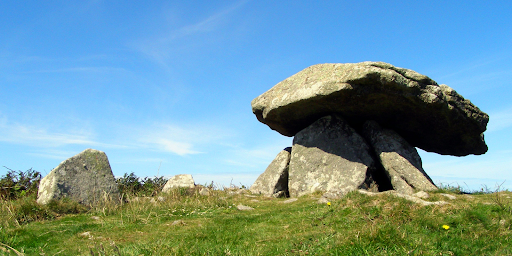
Photo by Jim Champion (treehouse1977), via wikimedia common
56